NFL Weather and Totals: How Wind, Rain and Cold Move the Over/Under
 Available in US
Table of Contents
- The Sunday morning I stopped trusting the forecast
- The fifteen-to-twenty miles per hour wind threshold that breaks passing offences
- Rain and the passing-yard problem
- Cold weather, scoring suppression, and the under-trend nobody talks about
- Dome games and the over that almost is
- How a UK punter actually checks the weather before kick-off
The Sunday morning I stopped trusting the forecast
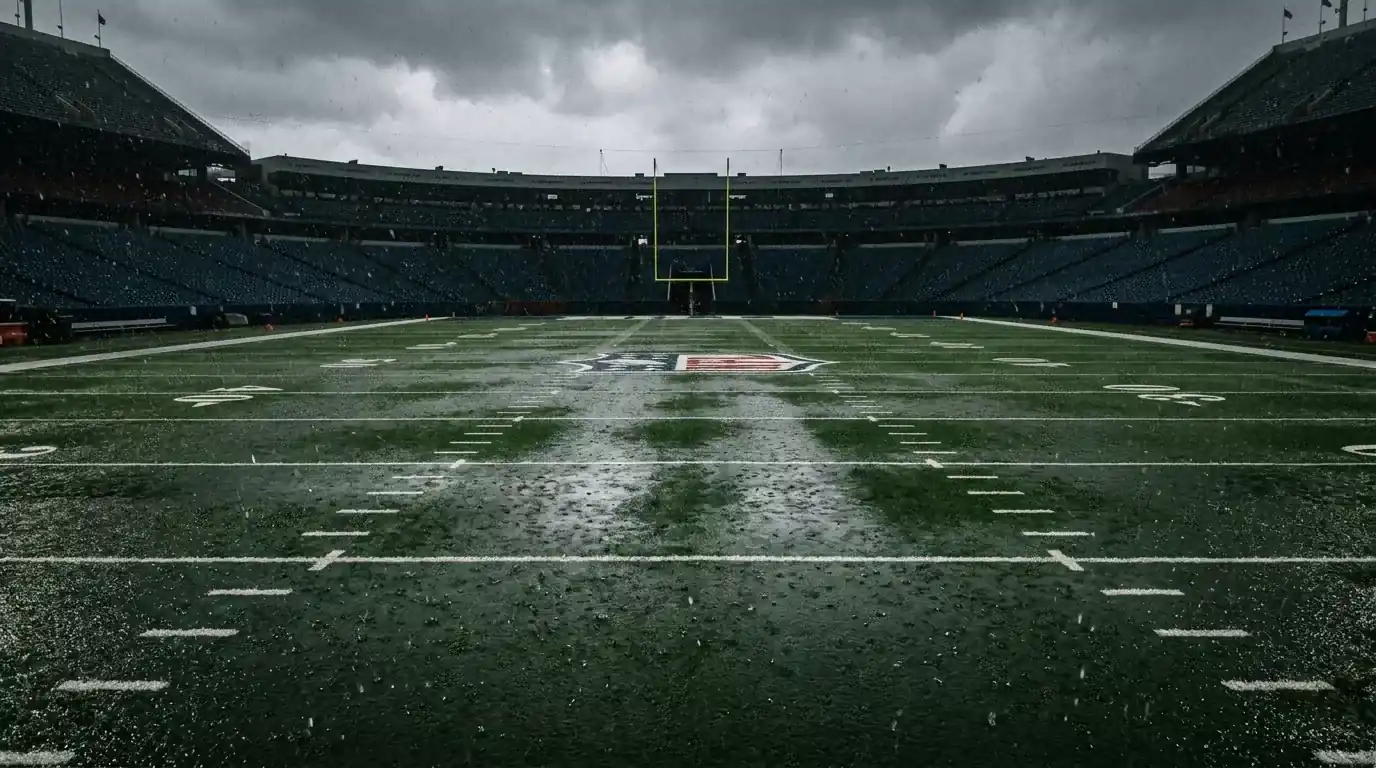
A few seasons back I had a Bills game totalled at 47, with a Wednesday wind forecast of eight miles per hour at Highmark Stadium. By Sunday morning the forecast had bumped to nineteen, with gusts in the high twenties. The total dropped to 41.5 over the course of three hours. I scrambled to take the under before it dropped further. The game finished 16-13. I tell that story not because I am proud of catching the move – I caught half of it – but because it taught me how aggressively the market reprices when the weather changes, and how many UK punters are still staking blind on Saturday-night lines that no longer reflect Sunday-morning conditions.
Roughly 76% of NFL bettors place their wagers on mobile, with the largest single segment placing 48% of all wagers pre-game. That pre-game volume is exactly the audience getting picked off when weather shifts on Sunday morning.
Apply weather data to NFL bye week ATS trends for outdoor games.
The fifteen-to-twenty miles per hour wind threshold that breaks passing offences
Wind is the only weather variable that consistently moves NFL totals, and the threshold most professionals use is the fifteen-mile-per-hour mark. Below fifteen, the effect on passing accuracy is small and the data shows totals hitting at roughly their expected rate. Between fifteen and twenty, completion percentages drop measurably and downfield passing efficiency starts to deteriorate. Above twenty, kicking distance shortens, deep throws become coin flips, and the game funnels into short passes and runs.
The market knows this. A total that opens at 47.5 on a Tuesday will routinely drop to 44.5 or even 43 by Sunday kick-off when the wind forecast crosses the fifteen-mph threshold. Historically, when wind is forecast at twenty or higher at game time, the under cashes at roughly 58% – well above the 52.4% break-even at standard −110 juice. The catch is that the line has usually moved before kick-off, so you are not getting the opening number.
Where the edge remains is in pre-game windows when forecasts are still uncertain. A Friday-afternoon forecast that shows fifteen-mph wind with the front still uncertain creates an opportunity to take the under before the consensus moves the line on Saturday or Sunday morning.
Rain and the passing-yard problem
Rain is harder to read than wind. Light rain – a few millimetres an hour – barely affects NFL games. Modern footballs are treated, grips are sticky, and quarterbacks at this level can throw a wet ball almost as accurately as a dry one. Heavy rain, the kind that turns a field into a paddling pool, is rare in the regular season but devastating when it happens. Total passing yards in those games drop by roughly 15-20% on average, and the under cashes at a rate around 55%.
The complication is that the rain itself is rarely the only variable. Heavy rain usually arrives with wind. A game played in a thunderstorm with sustained twelve-mph wind already has totals trending under from the wind alone. Pulling out the pure rain effect from the wind effect requires careful filtering, and I tend to treat rain as a confirming signal rather than a primary one. If the wind says under, and the rain says under, I am much more confident in the bet than if the wind alone is moving the line.
Cold weather, scoring suppression, and the under-trend nobody talks about
Sub-freezing games create a different set of effects. Footballs become harder. Hands get stiff. Kicking accuracy at distance drops materially below 32 degrees Fahrenheit. The cold also tends to favour the home team, which in late-season outdoor venues is usually the team built for it. Historical data shows that totals in games played below 25 degrees Fahrenheit cash under at roughly 53-54%.
That is a thin edge but a real one. The reason it survives is not statistical complexity but UK psychology. UK punters watching a game on a Sunday night, broadcast by Sky Sports, tend to back the over instinctively. American football looks fast and exciting on television. The Buffalo crowd is roaring. The numbers do not move them as aggressively as wind data does, partly because cold is harder to feel from the sofa than wind is to see when the broadcast cuts to a flag whipping on a goalpost. The 52.4% break-even threshold at standard juice means cold-weather unders sit just over the line – defensible but not generous.
Dome games and the over that almost is
The opposite extreme is the dome game. The conventional wisdom is that domes are over factories. Closed roofs eliminate wind. Climate control keeps the temperature stable. Receivers run cleaner routes, kickers hit from sixty, and quarterbacks throw without weather as an excuse. The intuition feels right.
The data is less dramatic than the intuition. Dome games over the last decade have hit the over at roughly 51%, barely above coin-flip and not enough to clear the vig at −110. The reason is that bookmakers have already priced the dome environment into the total. A Falcons home game might open at 49.5 specifically because the bookmaker has assumed climate-controlled scoring. The market expectations have absorbed the structural advantage.
Where the dome edge does exist is in late-season matchups when an outdoor team travels to a dome. Visiting offences that have spent November and December playing in wind get a clean field for a Sunday afternoon, and totals in that specific spot have ticked closer to 53-54% over. It is a narrow window, mostly weeks 13 through 17, and the volume is small. Treat it as a leaning point.
Visit nfl sports betting stats for situational NFL analysis.
How a UK punter actually checks the weather before kick-off
The practical workflow is short. I track three things from Friday onwards. First, wind forecast at game time, expressed in sustained miles per hour and gusts. Anything above fifteen mph sustained is a flag. Anything above twenty is a market mover. Second, temperature in Fahrenheit for outdoor games – UK punters need to translate from Celsius mentally, and the threshold to remember is 25 Fahrenheit, which is roughly minus four Celsius. Third, precipitation type and intensity. Snow is statistically similar to wind in its effect on passing; light rain barely registers; heavy sustained rain is a confirming signal.
The pre-game window between Saturday afternoon and Sunday kick-off is where most live weather movement happens, but bookmakers also reprice quickly in-play once kick-off conditions become apparent. The in-play markets – covered in more depth in the breakdown of how NFL live in-play betting has shifted in 2025/26 – sometimes lag the actual conditions, which creates fleeting opportunities in the first quarter. A team that is asked to throw into a swirling wind on its opening drive will tell you more about the rest-of-game total than any pre-game projection.
At what wind speed does the NFL total usually shift downward?
The fifteen-mile-per-hour sustained mark is the working threshold. Below fifteen, the market barely reacts. Between fifteen and twenty, completion percentages drop and totals routinely move two to three points down. Above twenty, the kicking and deep-passing games are materially affected and totals can drop four or five points from the opening line.
Are dome games statistically more likely to go over the posted total?
Only marginally. Dome games over the last decade have hit the over at roughly 51%, which is not enough to beat the 52.4% break-even at standard −110 juice. Bookmakers have already priced the climate-controlled environment into the total. The exception is late-season matchups where an outdoor team visits a dome – those have ticked closer to 53-54% over historically.
Written by the editors at nfl Sports Betting Stats.