NFL Key Numbers Explained: Why 3 and 7 Move Point Spread Pricing
 Available in US
Table of Contents
- Why a punter who ignores key numbers is losing money before kick-off
- What a key number actually is and why nobody talks about it in the pub
- The case for 3 and 7 being the only two numbers most punters need to learn
- What happens between 4 and 6, and why 10 occasionally matters too
- Buying off the 3, and why the bookmaker is not being generous
- Reading key numbers when the line comes in fractional
Why a punter who ignores key numbers is losing money before kick-off
The first time I bought a half-point off a +3 underdog on a Sunday-night NFL game, the bookmaker charged me an extra 12 pence on every pound, and the spread cashed by exactly a field goal. I won that bet because I treated the number 3 like it was sacred. In seven years of grinding NFL markets for UK clients, I have come to believe most punters lose their edge not on team selection – they lose it because they let the bookmaker park them on the wrong side of the most predictable number in American football.
Key numbers are the margins of victory that show up far more often than any model would expect if scores were distributed evenly. On the NFL, two of them – 3 and 7 – account for roughly a quarter of all final margins. The rest of this piece is about how to use that fact when you are looking at a fractional UK price like 10/11 on a +3.5.
Apply key numbers to NFL divisional game ATS stats for tighter picks.
What a key number actually is and why nobody talks about it in the pub
I used to play five-a-side football with a mate who has been betting NFL since the late nineties. He once told me, over a pint, that the only piece of betting knowledge he wishes he had learned earlier is which numbers actually matter. Everybody talks about Patrick Mahomes’ arm. Nobody talks about the fact that NFL games end on a margin of 3 nearly fifteen percent of the time.
A key number, in the simplest terms, is a winning margin that occurs disproportionately often because of the scoring structure of the game. American football scores in three-point field goals and seven-point touchdowns plus the extra point. That blunt arithmetic produces fat clusters of margins at 3, 7, 10, 14 and 17 – and almost nothing at 1, 2, 5 or 8.
This matters because bookmakers know the distribution as well as I do. They price spreads to push punters across these key numbers, charging extra juice when the line sits exactly on a 3 or a 7. The break-even rate on a standard −110 NFL spread is 52.4%, which means you need to beat the market four percent more often than a coin flip just to clear the vig. Moving the line across a key number can change your real cover probability by two or three percent on its own. That is the difference between a long-term loser and a long-term grinder.
The case for 3 and 7 being the only two numbers most punters need to learn
I keep a spreadsheet of every NFL final score going back to the 2000 season. The number 3 shows up as the final margin in around 14% of regular-season games. The number 7 follows at roughly 9%. No other margin breaks 6%. If you only ever memorise two pieces of NFL betting trivia, those are the two.
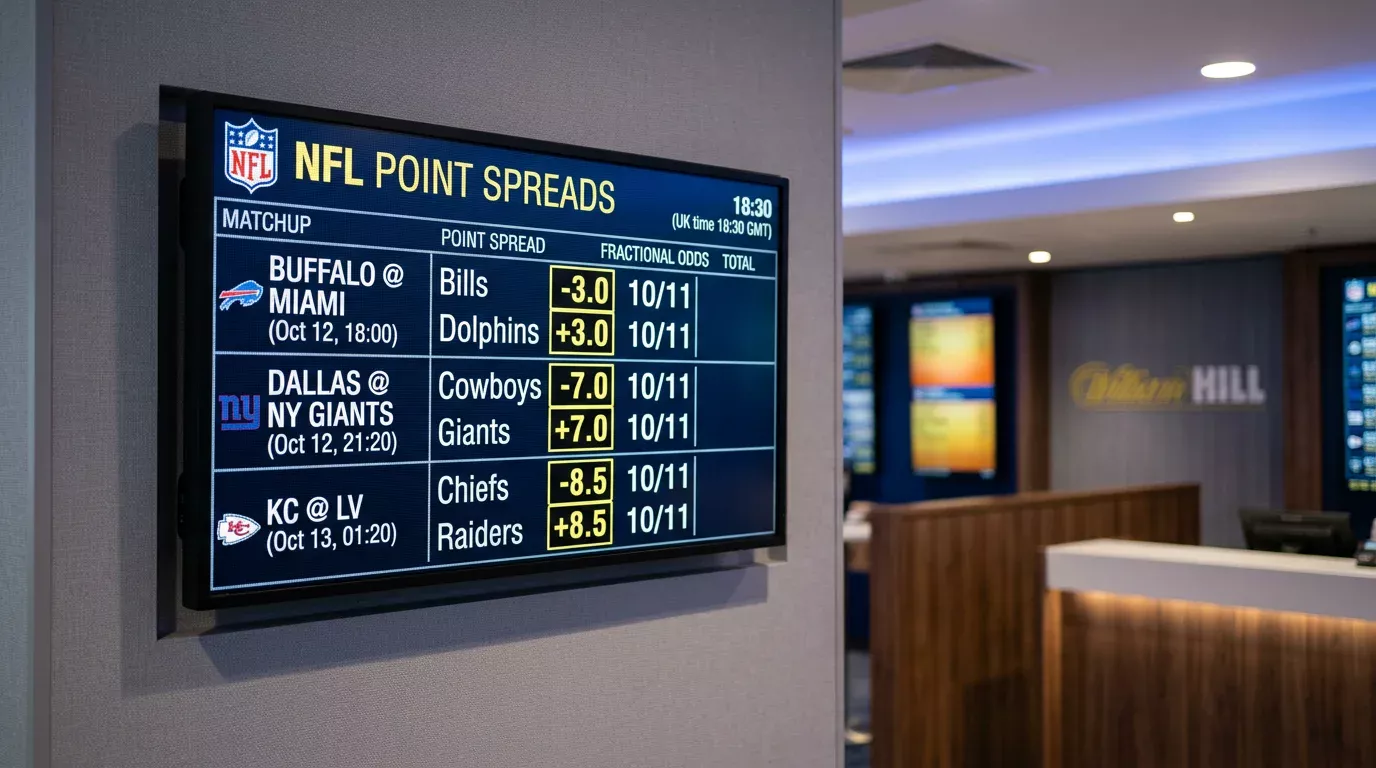
The reason 3 dominates is mechanical. Field goals are the cheapest legal score in football. A team trailing by 3 with two minutes left will accept a tying field goal rather than gamble on a touchdown drive. A team leading by 6 will kick the safe field goal rather than go for the touchdown on fourth down. Half of all close NFL games funnel into a 3-point margin, and the bookmakers price it accordingly. A line of −3 with juice at 5/6 on the favourite side and 10/11 on the underdog is the bookmaker telling you, in plain fractional, that they have priced in the fat tail.
Seven is the touchdown number. Final margins of 7 occur when one team scores exactly one more touchdown plus extra point than the other. In a sport where roughly half of all drives end in either a punt or a turnover and the scoring options are limited, that mirror-image scoreline is hard to avoid. I treat any line that sits on 7 – particularly +7 underdog tickets – as needing the same level of respect as a 3.
What happens between 4 and 6, and why 10 occasionally matters too
Margins of 10 are the third most common cluster, sitting at about 6%. A 10-point margin is a touchdown plus a field goal, the most economical way for one team to outscore another over four quarters. After 10, the curve drops off sharply.
The numbers 6 and 4 are interesting because they are key-adjacent. A margin of 6 occurs when a team wins by two field goals – about 5% of games. A margin of 4 is genuinely rare, under 3%, because there is no clean combination of NFL scores that lands there without two safeties or a missed extra point. When a spread sits between 4 and 6, the bookmaker has the luxury of pricing both sides at roughly the same juice because the cover probability does not change much across that range.
Around 60% of NFL bettors stake between £11 and £100 per wager. At that bet size, the difference between a +3 and a +3.5 ticket cashing or pushing is not academic. Across a 17-week season, the punter who tracks key numbers and refuses to lay −3.5 at standard juice will save themselves the equivalent of one losing bet per fortnight in expected value.
Buying off the 3, and why the bookmaker is not being generous
The half-point market exists because punters want to move their line across a key number and bookmakers are happy to sell that move at a price. Buying a half-point off +2.5 to +3 typically costs an extra 20 cents on the dollar in American odds, or roughly the equivalent of moving a fractional price from 10/11 to 4/6.
The question is whether that price is fair. The honest answer is: usually not, but sometimes very close. The cover probability on +3 is genuinely worth around five to seven cents in juice when you compare it to +2.5 historically. If a bookmaker is charging twenty cents, they are pocketing the difference. If they are charging eight cents during a promotion or a reduced-juice window, you are getting a defensible price. I never buy half-points off any number other than 3 or 7, and even then I want to see the price tighten before I commit.
Selling points – taking −2.5 and laying juice rather than the standard −3 – runs the opposite way. The bookmaker pays you to take on the worse number, but the discount they offer almost never compensates for the dramatic drop in cover probability. I have not sold a half-point off 3 in years and do not plan to start. The deeper mathematics of why this is true belong with the breakdown of vig and break-even calculations in our piece on NFL betting math, vig and closing line value, but the short version is that the bookmaker holds an asymmetric edge on point-buying ladders and uses key numbers to set the ladder rungs.
Explore nfl sports betting stats for NFL spread analysis.
Reading key numbers when the line comes in fractional
UK books default to fractional odds, which makes the juice harder to read than it should be. A line of 10/11 implies you stake eleven to win ten, which translates to roughly −110 in American format and about 1.91 in decimal. When a spread is sitting on the 3 with 10/11 either side, the bookmaker is showing you a fair two-way market. When the spread moves to 3.5 and the favourite shortens to 5/6 while the underdog drifts to evens, that is the bookmaker telling you the market just crossed a key number.
Pay attention to those moves. A line that shifts from −3 to −3.5 with a juice change of only one or two cents has likely moved on betting volume, not on a sharp re-evaluation. A line that crosses the 3 and immediately attracts juice asymmetry on the new side is the market acknowledging that the cover probability has genuinely shifted. As a UK punter, your job at that point is to decide whether the new juice is worth paying. Most of the time, it is not.
Should a UK punter buy a half-point off the 3 in an NFL spread?
Only when the price is genuinely fair. The cover probability on +3 is worth roughly five to seven cents in extra juice versus +2.5. If a bookmaker is charging much more than that – say twenty cents in American terms – you are overpaying and the long-run expected value turns negative. Watch the fractional price closely: a move from 10/11 to 4/6 to buy the half-point is usually too expensive.
Why is the 7 the second most important NFL key number?
Because a final margin of 7 occurs when one team scores exactly one more touchdown plus extra point than the other, which is the cleanest single-score advantage in the sport. Historically, around 9% of NFL games end on a 7-point margin, second only to the 3. Any spread sitting on the 7 – especially +7 underdog tickets in the playoffs – deserves the same careful pricing scrutiny as a 3.
Written by the editors at nfl Sports Betting Stats.