NFL Odds Conversion: Fractional, Decimal and American Side-by-Side for UK Punters
 Available in US
The reason a fractional punter loses money on American sites
A UK punter friend of mine signed up for a US-facing analytics service two seasons ago and immediately got confused. The picks were all written in plus-minus American format. He kept asking me whether −110 was a good price or a bad one, whether +135 was worth taking, whether −165 meant the bet was a heavy favourite or just a moderate one. The honest answer to all of these questions exists in any half-decent conversion table – but most UK punters do not internalise the relationship between the three formats and end up paying for the gap. Seven years on, I think mastering fluent conversion between fractional, decimal, and American is the single cheapest skill upgrade a UK NFL punter can make, because it unlocks all the analytics work that originates in American markets.
The break-even at standard −110 American juice is 52.4%, which translates to 10/11 in fractional and 1.91 in decimal. Memorising that one anchor point – and being able to derive other prices from it – is half the battle.
Apply your conversions to measure NFL closing line value accurately.
Fractional format recap for UK markets
Fractional odds are the UK default and they express the ratio of profit to stake. A price of 10/11 means you stake 11 units to win 10. A price of 5/2 means you stake 2 units to win 5. Total return is stake plus profit, so a £20 bet at 5/2 returns £70 – £20 stake plus £50 profit.
The implied probability of a fractional price is calculated as the denominator divided by the sum of numerator and denominator. For 10/11, that is 11 divided by 21, which equals 52.4%. For 5/2, it is 2 divided by 7, which equals 28.6%. The implied probability tells you the bookmaker’s view – adjusted for vig – of how often that price should win.
UK bookmakers express prices in fractional by tradition and because the format has been embedded in betting culture for over a century. Most casual UK punters use fractional intuitively without consciously thinking about implied probability – they translate 5/2 directly to “win £50 from a £20 stake” without converting to a probability. That intuition is fine for casual betting but limits the punter’s ability to compare prices across markets where the same true probability might be expressed at different price levels.
Decimal format mechanics
Decimal odds express the total return per unit staked, including the stake itself. A decimal price of 1.91 means a £10 stake returns £19.10 – £9.10 profit plus £10 stake. A decimal price of 3.5 means a £10 stake returns £35 – £25 profit plus £10 stake.
The implied probability of a decimal price is 1 divided by the decimal value. For 1.91, that is 0.524 or 52.4%. For 3.5, that is 0.286 or 28.6%. Decimal probability calculation is the cleanest of the three formats because the formula is a single division with no addition step.
Decimal format is the global standard outside the UK and US – most of Europe, Asia, and Australia use decimal by default. For UK punters working with analytical sources that originate outside the UK, decimal often appears in the source material. Becoming comfortable reading decimal is essentially a requirement for anyone using European or Australian betting analysis.
American plus-minus format explained for UK readers
American odds are the format used in US sportsbooks and most US-facing NFL analysis. The format has two parts: prices on favourites are expressed with a minus sign and a number (the stake required to win 100 units), prices on underdogs are expressed with a plus sign and a number (the profit on a 100-unit stake). A favourite at −110 requires a 110-unit stake to win 100 units of profit. An underdog at +135 returns 135 units of profit per 100 units staked.
The standard NFL spread juice of −110 is the American expression of fractional 10/11 – the price you pay to bet either side of an evenly balanced market with the bookmaker’s vig built in. The implied probability of −110 is 110 divided by 210, which equals 52.4%. The implied probability of +135 is 100 divided by 235, which equals 42.6%.
The plus-minus format takes some getting used to for UK punters because the relationship between the number’s magnitude and the implied probability runs in opposite directions on either side of the zero point. A larger negative number means a heavier favourite (−250 is more favoured than −150). A larger positive number means a longer underdog (+250 is a bigger dog than +150). The mental model becomes intuitive after the third or fourth conversion exercise.
Conversion tables that actually help
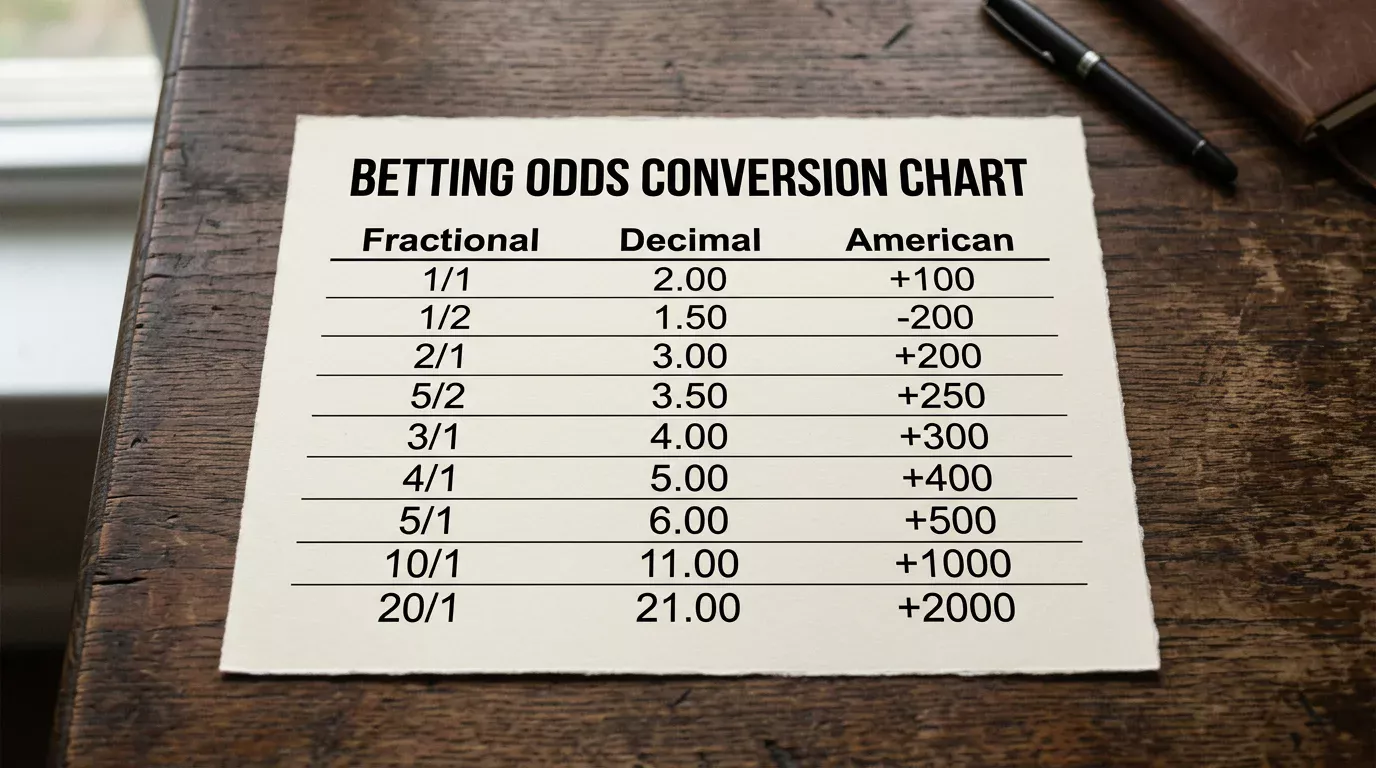
The cleanest way to internalise the three formats is to memorise five anchor points. American −110 equals fractional 10/11 equals decimal 1.91 equals implied probability 52.4%. American +100 equals fractional 1/1 (evens) equals decimal 2.00 equals implied probability 50%. American +135 equals fractional 27/20 equals decimal 2.35 equals implied probability 42.6%. American −165 equals fractional 4/6 equals decimal 1.61 equals implied probability 62.3%. American +250 equals fractional 5/2 equals decimal 3.50 equals implied probability 28.6%.
From those five anchors, most other common NFL prices can be approximated quickly. A price of −105 sits between −110 and +100, with an implied probability around 51.2%. A price of +110 sits between +100 and +135, with an implied probability around 47.6%. The underlying maths is the conversion formula, but in practice most punters who use these formats fluently are doing pattern recognition off the anchor points rather than fresh calculations each time. The structural relationship between these formats and the broader question of how NFL markets work in the UK – point spreads, moneylines, totals – is unpacked in our companion piece on how NFL betting odds work in the UK.
Visit nfl sports betting stats for all NFL odds tools.
Implied probability shortcuts and why they save real money
The reason implied probability matters more than the format itself is that it lets you compare prices across books, products, and markets directly. A fractional price of 4/5 implies probability 55.6%. A decimal price of 1.80 implies probability 55.6%. An American price of −125 implies probability 55.6%. The three prices are identical in their underlying expression of the bookmaker’s view of the event.
The practical shortcut UK punters should memorise is the relationship between fractional juice and implied probability for the standard NFL spread market. 10/11 is 52.4%. 5/6 is 54.5%. 4/6 is 60%. The shift from 10/11 to 4/6 – typically what a bookmaker charges to buy a half-point off the standard line – represents an increase in implied probability of 7.6 percentage points. If the underlying cover probability of the new line is not at least 7.6 points higher than the old line, the half-point purchase is structurally a bad bet.
As one US gaming industry voice put it about the broader expansion of legal sports betting in the country, the goal is to add atmosphere to games already meaningful to fans through legitimate, transparent markets. The transparency only translates into smart betting if the punter actually understands what the prices are saying. The 80% of NFL bettors who maintain accounts at two or more bookmakers have a structural advantage when reading these prices because they see the same market expressed multiple ways and can spot discrepancies. The 20% who do not are betting blind in a market that rewards literacy.
What is −110 American odds in fractional and decimal form?
−110 American equals 10/11 fractional and 1.91 decimal. The implied probability is 52.4%. This is the standard NFL spread juice and the price you typically see on both sides of an evenly balanced point-spread market. Memorising this conversion is the single most useful piece of cross-format knowledge for a UK NFL punter, because it lets you read US-originating analysis and compare it directly to UK book pricing.
Why do US sportsbooks use +/− odds while UK books default to fractional?
The formats developed independently in their respective markets and stuck for cultural reasons. American odds emerged from US horse racing and were adopted by sportsbooks because the +100/−100 anchor made it easy to read favourites and underdogs at a glance. Fractional odds in the UK trace back to centuries of bookmaking tradition. Decimal – the cleanest format mathematically – is the modern global standard everywhere except those two markets.
Written by the editors at nfl Sports Betting Stats.