NFL Parlay Risk: The Statistics Behind a Bet Type That Quietly Doubled in Popularity
 Available in US
The growth chart that should worry every UK punter who builds parlays
NCPG data shows that the share of US sports bettors placing parlay bets rose from 17% in 2018 to 30% by 2024. That is not a gradual shift. That is a near-doubling in six years, during a period when total sports-betting volume itself grew dramatically. Parlays are not just more common in absolute terms; they have grown as a share of total betting activity. After seven years of watching this market, I have come to believe parlays represent the single most successful product innovation in modern sports betting – successful for the bookmaker, structurally costly for the punter. That is not a moral judgement. It is what the numbers say.
The break-even on a standard NFL spread at −110 juice is 52.4%, which corresponds to a hold of roughly 4.5%. The break-even on a four-leg NFL parlay at typical pricing is closer to 75% per leg combined, against a structural hold of 18-22%. Those numbers are not in the same conceptual neighbourhood.
How parlay share climbed from 17% to 30%
The NCPG’s NGAGE 3.0 survey identified the parlay-share growth as one of the most pronounced behavioural shifts in US gambling activity over the 2018-2024 window. Around 20 million US adults reported at least one problem-gambling behaviour in the 2024 survey, down from 27.5 million in 2021 – a decline in absolute terms but still a large number relative to the betting population.
The growth in parlay participation tracks the rollout of same-game parlay and bet-builder products. Before 2019, parlays were largely cross-game constructions – bettors had to combine results from different games to build the multi-leg ticket. After 2019, the introduction of in-game parlay products allowed bettors to combine multiple bets from a single game into a single ticket. The product expansion gave casual bettors a way to engage with one game across many markets simultaneously, which translates into substantially higher per-bettor parlay volume.
The 17%-to-30% shift is not just a participation increase. It is a structural shift in how bettors interact with NFL games. The single-bet, single-game model has been partially replaced by a multi-leg, single-game model, and bookmaker revenue per bettor has climbed correspondingly.
The compounded house edge across multi-leg tickets
The mathematical reason parlays favour the bookmaker so heavily is that the hold compounds across legs. A two-way bet at 10/11 each side carries an overround of 104.8% and an effective hold of about 4.5%. Combining two such bets into a parlay does not simply double the hold – the bookmaker’s correlation adjustments and pricing engine compound the effective margin. A two-leg NFL parlay typically runs at an effective hold of 7-9%. A three-leg parlay at 12-16%. A four-leg parlay at 18-22%.
The compounding is partially structural – multiplying together two prices that each contain a margin produces a combined margin larger than either alone – and partially intentional. The pricing engine on multi-leg products adjusts correlation between legs in a way that consistently favours the bookmaker. A bettor combining two anti-correlated legs (legs that are less likely to both hit than naive multiplication suggests) might receive a price that is fair or slightly favourable; a bettor combining two positively correlated legs almost always receives a price that has been adjusted in the bookmaker’s favour by more than the true correlation warrants.
Correlation and the rise of junk parlays
The phrase “junk parlay” is industry shorthand for a multi-leg ticket where the legs were not selected for value but for entertainment – combining six anytime touchdown legs across two games, for example, or stacking four passing-yards overs with no underlying analysis. The legs are functionally random with respect to value, the combined hit rate is very low, and the compounded hold consumes any nominal edge the picks might have had.
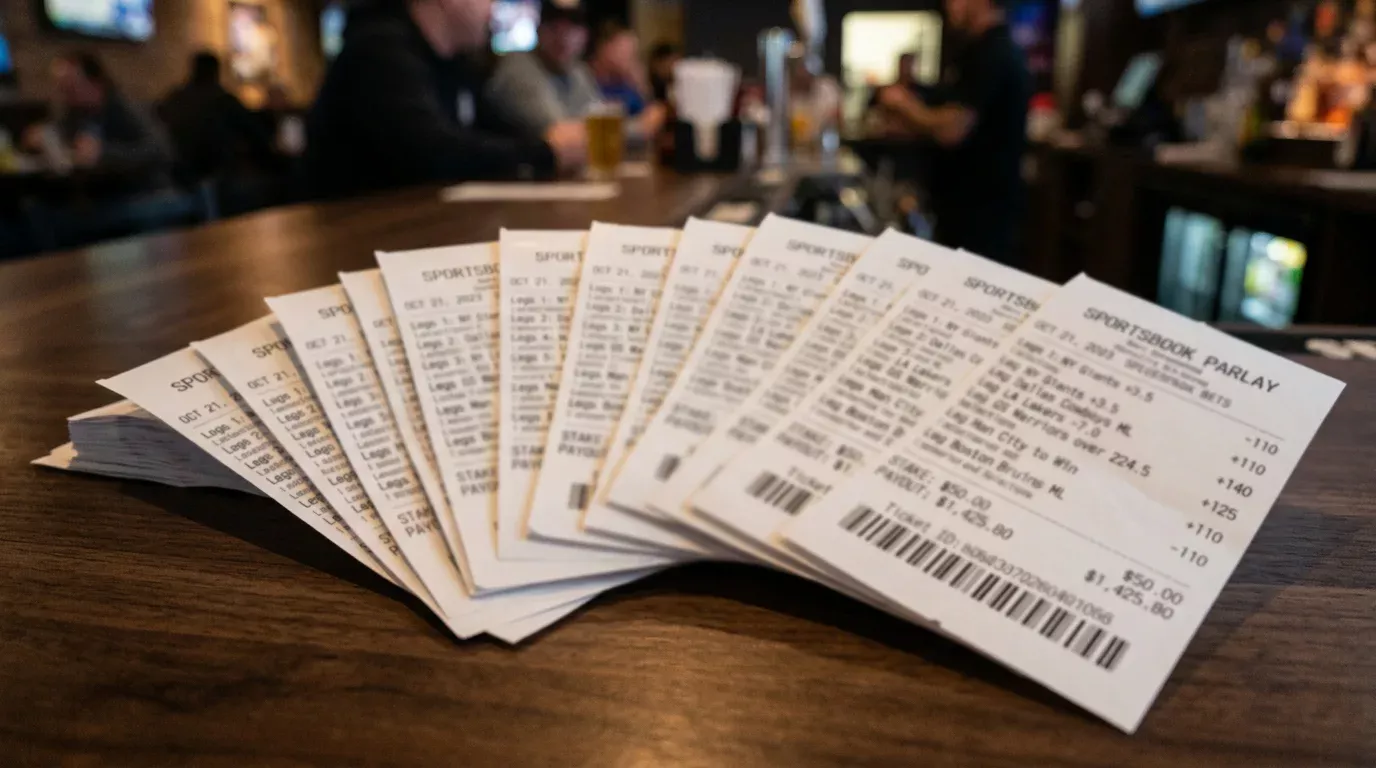
Junk parlays are not always intentional. Many UK punters build them by clicking through a few legs of a Sunday slate without checking the prices or the implied probabilities. The bet builder interface on Sky Bet and Paddy Power makes the construction visually attractive and quick. The downside, which the interface does not display in the same prominent way, is that each additional leg compounds the structural hold further and further. A six-leg ticket at typical pricing carries an effective hold of 25-35%, which is closer to a casino slot game than to a sports bet.
Optimove research shows 60% of NFL bettors stake between £11 and £100 per wager, and a substantial fraction of that volume sits in multi-leg constructions. The volume confirms what the NCPG growth chart shows: parlays are not a niche product anymore. They are mainstream, and the mainstream bettor is paying a structurally large premium for the format.
Parlays and problem gambling correlation
The Siena College research on US sports fanship in 2025 identified that 20% of online sports bettors show signs of dependence and another 30% fall into an at-risk category. Among NFL bettors specifically, up to 60% have admitted to staking more than they could afford to lose. The Optimove 2024 research figure of 66% of NFL bettors admitting to overstaking – up from 45% the previous year – confirms the broader picture.
The correlation between parlay participation and problem-gambling indicators is documented but not universally agreed in academic literature. The mechanism is straightforward: parlays offer large nominal payouts at small stakes, which creates a psychological hook that makes loss-chasing more likely. A punter who lost £10 on a £1 four-leg parlay does not feel the loss the same way they would feel a £10 spread loss, but the bookmaker’s hold extracted from the stake is structurally larger. The compounding effect across many tickets accumulates without the punter consciously tracking the cumulative damage.
For higher-risk punters, the parlay product is structurally more dangerous than straight betting because the hold is larger and the variance is wider. The UKGC’s safer-gambling framework – including the affordability checks discussed in our piece on UKGC safer-gambling rules for NFL bettors – applies more aggressively to high-stake parlay players than to equivalent spread players, partly for these reasons.
Safer parlay rules that actually work
For UK punters who still want to bet parlays – which is a legitimate recreational choice – three rules contain the damage without removing the entertainment. First, cap parlay legs at three. The hold differential between three-leg and four-leg parlays is large enough that staying at three preserves most of the entertainment value while substantially reducing the effective house edge. Second, size parlay stakes at no more than 0.5% of bankroll per ticket. Variance on parlays is so high that even well-constructed tickets resolve to losses most of the time; sizing prevents the variance from compounding into damaging drawdowns. Third, set a weekly parlay cap measured in tickets rather than stakes. A maximum of three parlay tickets per NFL weekend creates a hard ceiling on cumulative exposure regardless of how the individual tickets perform.
Those rules will not transform parlay betting from negative-expected-value to positive-expected-value. Nothing will. They will prevent parlay betting from becoming the dominant share of a UK NFL punter’s bankroll, which is the failure mode the NCPG data is documenting. The 17%-to-30% growth in parlay participation has happened against a backdrop of stable or rising problem-gambling indicators. The pattern matters because both numbers are large and they are moving in the same direction.
By how much has NFL parlay participation grown since 2018?
The NCPG NGAGE 3.0 survey identified that the share of US sports bettors placing parlay bets rose from 17% in 2018 to 30% by 2024 – roughly a doubling in six years, during a period when total sports-betting volume itself was growing dramatically. The growth tracked the introduction of same-game parlay and bet-builder products, which gave casual bettors a way to combine multiple bets from one game into a single ticket.
Are NFL parlays correlated with higher problem-gambling rates?
The correlation is documented but not universally agreed in academic literature. The mechanism is structural – parlays offer large nominal payouts at small stakes, which creates a psychological hook that makes loss-chasing more likely. Among NFL bettors specifically, up to 60% have admitted to staking more than they could afford to lose, with Optimove research showing the figure rose to 66% by 2024 from 45% the prior year. Multi-leg products are over-represented in that staking pattern.
Written by the editors at nfl Sports Betting Stats.