How NFL Betting Odds and Markets Work in the UK: Spreads, Moneylines and Totals Explained
 Available in US
Table of Contents
- The first NFL bet that taught me everything
- The three core markets, and why the others are sideshows
- How point spreads actually work
- How moneylines work in fractional UK pricing
- Totals over/under — why so many NFL games land in the 44–47 range
- Fractional, decimal and American odds — the same number in three suits
- Vig, hold and the 52.4% rule
- Alternate lines and the half-point premium
- Pre-game vs live betting on NFL
- The UK NFL bookmaker landscape, factually stated
- Frequently Asked Questions

The first NFL bet that taught me everything
The first NFL bet I ever placed in the UK was a Bills moneyline at 4/9 in 2018. I won £2.22 on a fiver and spent the next hour staring at the bet slip trying to work out whether that was good value, bad value, or just a number the bookmaker had pulled out of a hat. Seven years later I can tell you it was none of those — it was the operator pricing the implied probability of a Bills win at about 69.2%, taking a hold of about 4.6% across the two-way market, and rounding to the nearest fractional tick they had on file.
If that sentence reads like Klingon, this article is for you. UK NFL betting runs on three core markets, two odds formats most punters never need to convert, and one piece of arithmetic — the vig — that quietly takes a fixed percentage off every long-run punter who hasn’t thought about it. I’ll walk through all of it the way I’d explain it to a mate who’s deciding whether to put a fiver on Sunday’s late game.
Convert between formats with our NFL odds conversion guide.
The three core markets, and why the others are sideshows
Eight out of ten NFL bets in the UK go through three markets: the point spread, the moneyline and the totals over/under. Optimove’s most recent NFL wagering data has 48% of bets settled pre-game, only a quarter live, and around three-quarters placed via mobile — the texture changes, but the markets that take the action don’t.
The spread is a handicap. The bookmaker tells you the Bills are 3.5-point favourites at Cleveland, and your bet is on whether the Bills win by at least four or the Browns lose by three or fewer (or win outright). The moneyline strips the handicap out and just asks who wins. The totals market asks whether the two teams combined score over or under a stated number — 44.5, say.
Bet Builders, player props, futures and live wagers all matter, but as a share of UK NFL handle they’re the side dishes. Spread, moneyline and totals are the main course. If you understand how the operator prices and balances those three, you understand 90% of UK NFL betting. Everything else is a permutation.
How point spreads actually work
The mental shortcut I use for new punters: a point spread is a handicap that converts an unbalanced game into a coin-flip-priced bet. The bookmaker doesn’t want 80% of the money on the Bills against the Browns. They want it close to 50/50 so they can collect the vig and walk away regardless of who wins. The spread is the lever they use to do that.
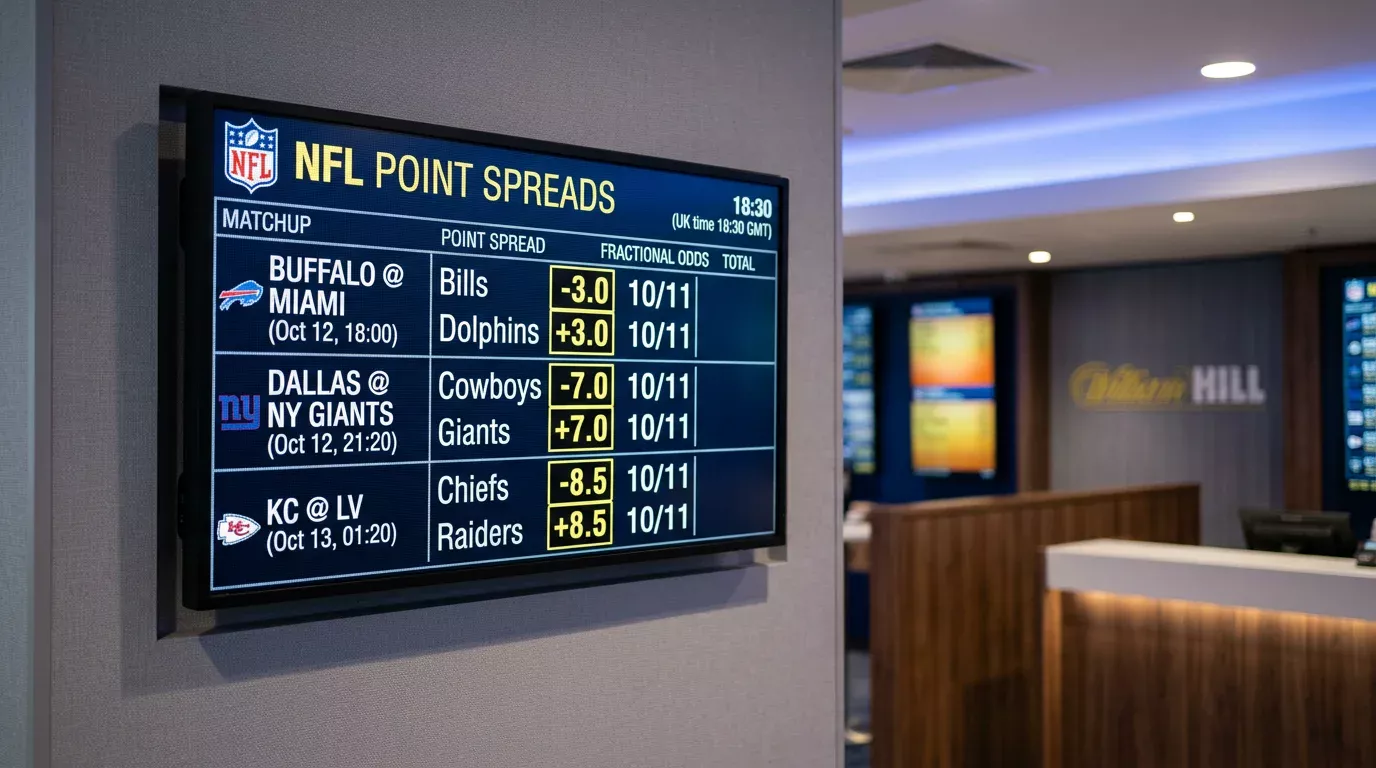
Pricing example. The Bills are −3.5 favourites against the Browns. In American format both sides typically come in at −110. In UK fractional that’s usually quoted at 10/11 on each side: stake £11 to win £10, or stake a tenner to win £9.09. Put a £10 on the Bills −3.5 at 10/11, you get back £19.09 total if the Bills win by four or more. If they win by three or fewer, or lose, your stake is gone.
The 0.5 — the “hook” — matters because NFL margins of victory cluster at very specific numbers. Roughly 15% of NFL games end with a 3-point margin and another 9% with a 7-point margin. The hook is the bookmaker’s way of guaranteeing nobody pushes — a bet that lands exactly on the spread is a refund in most operator terms, and bookmakers prefer to avoid it. Pricing −3.5 instead of −3 forces a decision: either the favourite wins by four or more, or they don’t.
The spread itself can move from open to close. When sharp money hits one side the operator nudges the number. A Bills line that opens −3 and closes −3.5 has been bought by serious bettors at the lower price; by Sunday the −3.5 is in some sense the “true” market view. The opening line is the bookmaker’s best guess; the closing line is the market’s verdict.
One last piece. The standard −110 (or 10/11) juice is itself a tunable variable. You’ll sometimes see −105 (roughly 20/21) on reduced-juice promotions, or −115 (4/5) when the bookmaker thinks one side is under-priced. Always look at the price next to the number, not just the number.
How moneylines work in fractional UK pricing
The moneyline question is the one your dad understands instinctively: who wins. The pricing is where UK punters can get tripped up, because fractional moneyline prices on heavy favourites get tight and on heavy underdogs get loose, and the conversions aren’t intuitive at a glance.
Take the same Bills-Browns game. The Bills as 3.5-point favourites might be priced at around 4/9 on the moneyline. That’s 13/9 return, or an implied probability of 69.2% (a 4/9 punt needs to win nine times in thirteen at that price to break even before vig). The Browns moneyline might be priced at 2/1 or thereabouts — bet a tenner, win twenty, implied probability 33.3%. Add the two implied probabilities together and you get 102.5%. That extra 2.5% is the bookmaker’s overround on the two-way moneyline market. It’s the vig in another form.
The fractional UK convention for very short favourites — 1/4, 1/5, 1/6 — is to add the denominator to your stake to calculate return. Bet £5 at 1/4, win £1.25 plus your stake back: total £6.25. The same in decimal would be 1.25; in American, −400. Same bet, different clothes.
NFL moneylines are most interesting when the spread is small. A pick-em with both sides at evens on the spread might price moneylines at 5/6 and 5/6 — almost identical, because the game is close to a coin flip. As the spread widens, the moneylines diverge sharply: a −9 favourite might be priced 1/4 on the moneyline against a 3/1 underdog. The spread tells you who’s “supposed to” win; the moneyline tells you the probability the market assigns to that supposed outcome.
Totals over/under — why so many NFL games land in the 44–47 range
Most UK punters arriving at NFL from football are surprised that the totals number is a real bet rather than a sideshow. On a Premier League fixture the totals market is usually quiet. On an NFL fixture it’s frequently the most-traded line on the slip.
The totals number — let’s say 44.5 — is the bookmaker’s prediction of the combined points scored by both teams. You bet over or under at typically 10/11 each way. Hit £10 on the over at 10/11, you collect £19.09 if the combined score lands at 45 or higher. The 0.5 hook does the same job as in the spread: nobody pushes.
Why do so many NFL totals cluster between 44 and 47? Because the league’s average team score over the last several seasons has hovered between 22 and 24 points per game. Combine two average-ish teams and you get a total in the mid-40s. Bookmakers calibrate to the historical baseline, then adjust for two factors: the offensive and defensive efficiency of the specific teams, and the projected pace. A Lions-Bills game with two top-ten offences and below-average defences might price 51.5. A Patriots-Jets game with the league’s worst offences and decent defences might price 38.5.
Weather is the third factor, and it’s where UK punters can have an edge if they watch the forecast. Outdoor games in serious wind — 15 mph or more — typically see totals shaved by 2 to 3 points before kick-off. Rain matters less than wind. Cold matters less than wind. If you check the Friday forecast and the bookmaker hasn’t moved the line by Saturday, that’s information.
And yes, alternate totals exist. Want over 48.5 instead of over 44.5? Most UK apps will quote a price — typically much longer fractional odds because the over now needs more points to land. We’ll come to that in the alternate lines section.
Fractional, decimal and American odds — the same number in three suits
Most UK punters under 35 toggle their app to decimal odds and never look back. Most over 50 stay on fractional because they grew up with it. Both groups are pricing the same probability; the formats just present it differently.
Take −110 American, the bedrock NFL spread juice. In decimal, that’s 1.909. In fractional, that’s 10/11. All three express the same break-even hit rate of 52.38%. Take 4/9 — the Bills moneyline above. In decimal that’s 1.444. In American it’s −225.
The conversion formulas are simple once you’ve stared at them twice. Fractional to decimal: divide the fraction and add 1. So 10/11 = 0.909 + 1 = 1.909. Decimal to fractional: subtract 1, then express as a fraction. 1.909 − 1 = 0.909 = 10/11. Decimal to implied probability: 1 divided by the decimal odds. 1/1.909 = 52.38%.
The trap UK punters fall into is mistaking the format for the value. A price of 10/11 isn’t worse than 1.909 — they are literally the same offer. A price of evens (1/1) isn’t worse than 2.00 in decimal — same number. The only time the format actually matters is when you’re comparing prices across operators that show different defaults, and then it pays to learn one mental conversion you trust.
If you want to drill down on every conversion edge case — including how American +/− crosses over to fractional ticks the UK industry actually quotes — we’ve written a separate piece on how to convert NFL odds between fractional, decimal and American formats. The shortcut for now: stick with one format, learn its implied probabilities, and check the others only when arbitraging.
Vig, hold and the 52.4% rule
The single most useful number in NFL betting maths is 52.38%. Round it to 52.4 and use it as a mental anchor: that’s the hit rate you need on point spreads priced at standard −110 (or 10/11) to break even before the vig eats your bankroll.
The arithmetic. At −110, you risk £11 to win £10 on each side. Across two bets — one win, one loss — you stake £22 and win back £21. Your loss is £1 on £22 staked, or 4.55%. That’s the long-run hold the bookmaker takes from the average punter who picks 50/50. To overcome it, you need to win at a rate higher than 50%. Specifically, you need to win 11 out of every 21 bets, which is 52.38%.
The cumulative effect is brutal. Over a 17-week NFL season at five bets a week, a punter at 50% accuracy loses 4.55% of their handle. A punter at 52.4% breaks even. A punter at 55% earns a thin edge. A punter at 57% — the level a serious sharp aspires to over a full season — earns a real one. The gap between losing money slowly and making money slowly is roughly five percentage points of accuracy. That’s the whole NFL betting industry compressed into one line.
Bet Builders and parlays are not exempt from this maths. They concentrate vig: a four-leg same-game parlay on NFL at standard pricing has an implied hold of around 12 to 18%, depending on the correlation handling and leg structure. Higher payouts, longer odds, but a much bigger house edge than a straight spread bet. That’s not a moral judgement on parlays — it’s just where the maths lives.
Alternate lines and the half-point premium
Once you’ve understood the standard spread, totals and moneyline, the alternate lines product becomes obvious. The operator lets you move the line up or down in half-point or whole-point increments, and reprices the bet accordingly. Want the Bills at −2.5 instead of −3.5? That’s an alternate spread, and you’ll pay a worse price — maybe 1/2 instead of 10/11 — because you’ve moved through the 3 key number into safer territory for your bet.
The half-point premium is where the maths gets interesting. Buying a half-point off the standard −3 spread typically costs the punter around 24 cents in American odds, taking the price from −110 to roughly −134. In fractional that’s a move from 10/11 to about 4/7. Whether that’s worth it depends on the actual frequency of 3-point games in the era you’re betting on, which has hovered between 14 and 15% in recent NFL seasons. If you cross 3 to get to 2.5, the half-point is meaningful. If you cross 4 to get to 3.5, it’s almost worthless because 4-point games are rare.
The same applies to totals. Buying a half-point off 44.5 down to 44 is cheap in expected value if the historical frequency of 44 as a final combined total is low. Most UK apps will let you alternate totals up to 10 points either side of the posted line; the further you move, the longer the odds.
One practical note. Alternate lines are where bookmakers often hide the worst pricing in the slip. The standard −110 spread is closely watched and tightly priced. The alternate −2 spread at 1/3 — much less so. Cross-check with at least one other operator if you’re going to buy points regularly.
Pre-game vs live betting on NFL
Live, or in-play, NFL betting has shrunk as a share of total NFL handle in the UK over the last two seasons. Optimove’s 2025/26 figures show in-play down to 25% of NFL bets, with 48% settled pre-game and the remainder spread across futures, props and Bet Builders that may technically settle in-play but originate pre-kick.
Why has live lost ground? Three reasons. One, the operator margins on live are wider — typically 6 to 8% hold versus 4 to 5% pre-game — and savvy punters have noticed. Two, the broadcast latency on UK streams of NFL games makes timing-sensitive live betting difficult: by the time you see the play, the market has moved. Three, mobile UI fatigue. UK punters increasingly want to set a bet on Friday and watch the game on Sunday, not refresh an app every 20 seconds.
That doesn’t mean live betting is dead. It still accounts for one in four NFL bets, and on red-zone trips, fourth-down decisions and second-half adjustments the live line can move significantly off the pre-game number. Live is where micro-bets — yes/no on the next play, drive total, third-down conversion — make most of their money. Optimove’s Tomer Imber called the modern bettor’s expectation a desire for “personalised, real-time, mobile-first experiences” — that’s what the live product is trying to be, even if pre-game still wins on handle.
My own habit, for what it’s worth: pre-game for spreads and totals, live only for specific situational bets — a heavy favourite trailing at halftime where the spread has overcorrected, or a totals under bet on a game I expected to be a punt-fest that’s still 10-7 in the third quarter. Live as a tactical tool, not a habit.
The UK NFL bookmaker landscape, factually stated
The UK NFL betting shortlist is shorter than it looks if you walk past the affiliate sites. In practice, the operators that publish a full-coverage NFL product — early lines, Bet Builder, props, futures, alternate lines, live — number maybe eight to ten. bet365, Sky Bet, Paddy Power, William Hill, Betfair, Coral, BetVictor, Ladbrokes. Some specialist exchanges and a few smaller bookmakers offer thinner NFL coverage.
The Flutter platform migration in 2025 reshaped this materially. Before the migration, Sky Bet’s NFL product was substantially smaller than Paddy Power’s — fewer markets, no Bet Builder, lighter props menu. After the migration, Sky Bet, Paddy Power and Betfair all access the same FanDuel-derived NFL pricing and the same Bet Builder engine. The 2025/26 season was the first in which Sky Bet customers could build NFL multis the same way Paddy Power customers had been doing since 2022. Flutter’s UK and Ireland trading manager Nicola O’Sullivan described it bluntly when the change went live: customers suddenly had “access to hundreds of new markets”, and the operator launched matched Bet Builders to push adoption.
For the UK punter the practical effect is that price comparison across Flutter brands is largely pointless on NFL — the same engine, the same numbers. Where comparison still matters is across the boundary between Flutter, bet365 and the rest, because they price independently and the differences on, say, alternate spreads or anytime touchdown scorers can be meaningful. Get into the habit of checking two or three operators before placing anything bigger than a fiver.
See also: nfl sports betting stats for NFL odds essentials.
Frequently Asked Questions
What does a fractional price like 10/11 actually return on a £10 NFL stake?
At 10/11, a £10 stake returns £19.09 in total if the bet wins — that’s your £10 stake back plus £9.09 profit. The fraction works as ‘risk 11 to win 10’, so per unit of stake you collect 10/11 of that stake as profit. The same price expressed in decimal is 1.909, and in American it’s −110.
Why is the standard NFL spread juice −110, and what does it cost the bettor?
The −110 juice is the bookmaker’s overround on a two-way spread market. It means you stake £11 to win £10 on each side, which gives the operator a long-run hold of about 4.55% on the total handle. To overcome it and break even, a punter needs to win at a rate above 52.38% — the magic break-even number that defines profitable spread betting.
What is a key number in NFL point spread betting, and which numbers matter most?
A key number is a point margin that NFL games land on more often than average because of the scoring system. The two biggest are 3 and 7, driven by field goals and unconverted touchdowns. Around 15% of NFL games end at a 3-point margin and 9% at 7 points. Spreads priced on or near 3 and 7 are watched closely by bookmakers and sharp punters.
Why do NFL totals sit so often around 44–47 points, and how do bookmakers set the number?
NFL totals cluster in that range because the league’s average team score has hovered between 22 and 24 points per game in recent seasons, so two average teams produce a combined total in the mid-40s. Bookmakers calibrate to the historical baseline, then adjust for each team’s offensive and defensive efficiency, pace and weather conditions. Outdoor games with sustained wind above 15 mph typically see the total shaved by 2 to 3 points.
Written by the editors at nfl Sports Betting Stats.